

On October 20, 2026, China’s Ministry of Industry and Information Technology (MIIT) opened a public consultation on the Guidelines for Developing the National Internet of Vehicles Technical Standards System (2026 Edition). Comments are accepted until November 18, 2026. The draft package comprises an overarching framework and five sector-specific guidelines covering intelligent and connected vehicles, information and communications, intelligent transportation, intelligent vehicle management, and electronic products and services. Official consultation notice
The documents propose coordinated standards development across vehicles, infrastructure, communications networks and service platforms. They are planning instruments rather than immediately applicable product requirements. Individual standards, their legal status and implementation dates will depend on subsequent development and publication.
A Coordinated Framework for Connected Mobility
The overarching guideline targets a comprehensive national Internet of Vehicles (IoV) technical standards system by 2030. It seeks to coordinate automotive, telecommunications, transport, public-security and electronics requirements, supporting both vehicle intelligence and connectivity-enabled functions.
The package builds on earlier sectoral guidelines, including the 2023 intelligent and connected vehicle edition. That framework already promoted coordination with communications, intelligent transportation and smart-city development. The 2026 proposals provide a broader, updated roadmap addressing emerging technologies and deployment needs. MIIT’s 2023 framework
Five Areas of Standards Development
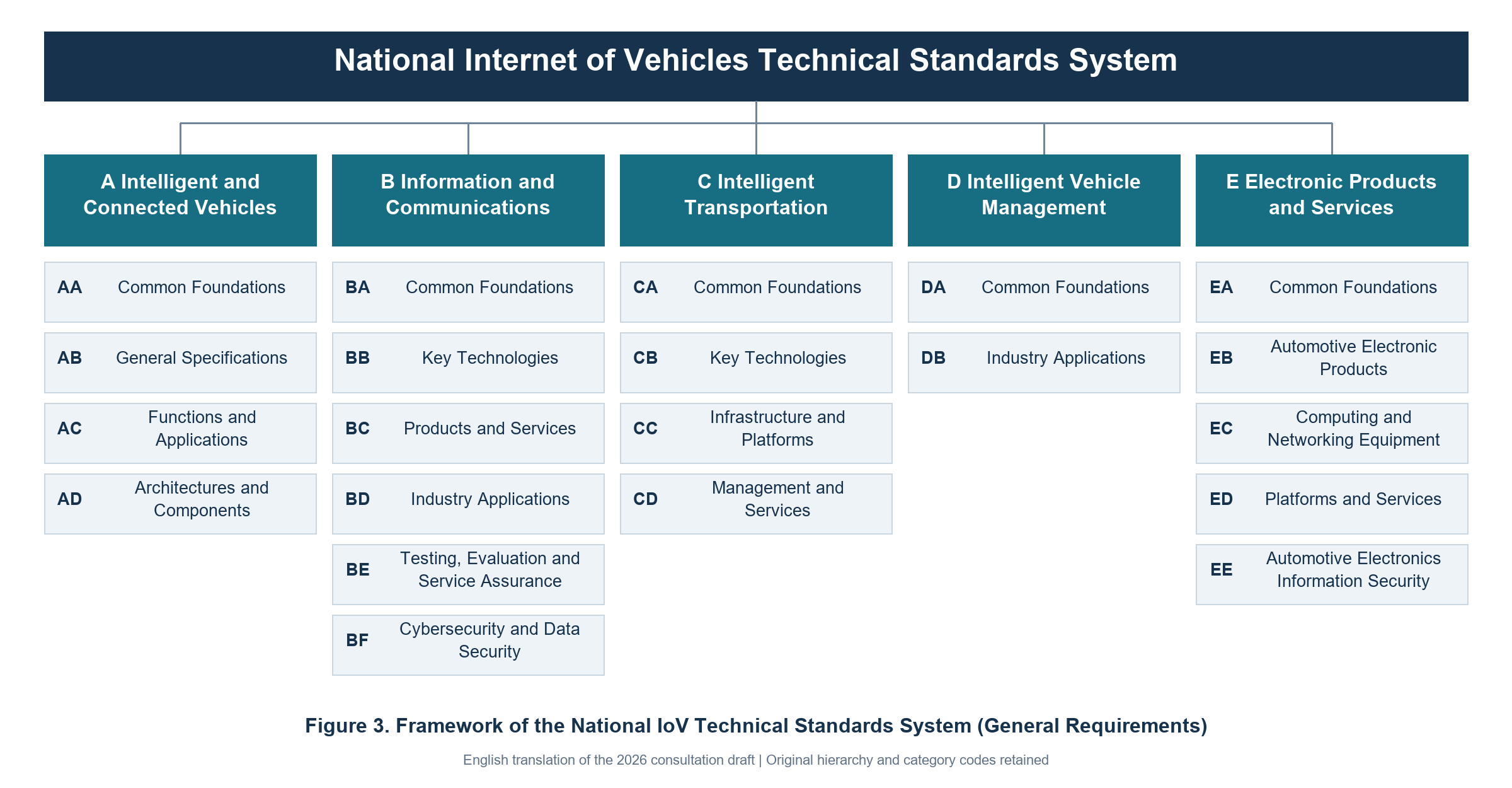
The intelligent and connected vehicle guideline proposes developing or revising more than 140 standards by 2030, rising to more than 200 by 2035. Its framework covers foundational concepts, general specifications, functions and applications, and architectures and components. Priorities include automated driving, intelligent cockpits, human-machine interaction, automotive artificial intelligence, data applications and vehicle software.
The information and communications guideline targets more than 100 standards by 2028 and more than 150 by 2030. It supports coordinated deployment of direct and cellular communications, vehicle-road-cloud cooperation, testing, service assurance, and cybersecurity and data security. It also proposes exploring automotive requirements for future technologies, including 6G.
The intelligent transportation guideline proposes more than 30 standards by the end of 2028 and more than 40 by 2030, addressing infrastructure, sensing, information exchange, traffic control, mapping, positioning and transport services.
The intelligent vehicle management guideline targets more than 15 key standards by the end of 2028 and more than 30 by 2030. It focuses on registration, identity authentication, road operation and cooperative vehicle-road management.
The electronic products and services guideline proposes more than 50 standards by 2030, covering onboard devices and modules, computing and networking equipment, software, platforms and security.
These are sector-specific planning targets and should not be added together as a confirmed total of distinct new standards.
Figure 3 from the document shows the China IoV Technical Standards system.
Implications for Hardware and Software Suppliers
For semiconductor and electronics suppliers, the proposals identify future standardization areas including automotive-grade radio-frequency devices, high-reliability storage, sensing components and communication modules. Topics extend to interfaces, packaging, environmental adaptability, fault detection and testing.
Connectivity suppliers should monitor both the communications and electronics guidelines. Requirements may emerge at different integration levels, from chips and modules to onboard terminals, roadside units and platforms. Suppliers should assess how these layers interact rather than treating each guideline as a separate compliance exercise.
Software receives substantial attention. Proposed areas include operating systems, middleware, application interfaces, algorithm frameworks, compatibility testing, version traceability and development tools. Security topics include application permissions, cloud-platform access controls, API protection and secure over-the-air updates.
The documents identify areas for standards development; they do not establish final technical specifications for every listed technology or create a new standalone certification requirement for all components.
Analysis & Recommendations
BESTAO considers that the package signals a stronger emphasis on compatibility and coordination across the connected-mobility ecosystem. Suppliers may increasingly need to demonstrate how their products operate within vehicle, roadside and cloud architectures, alongside component-level performance.
International businesses should map relevant sections against their Chinese product portfolios and customer programmes. Automotive suppliers should track architecture, software and safety work; communications suppliers should follow interoperability, testing and service requirements; platform providers should review interfaces, data management and operational security.
The communications guideline also encourages engagement with international organisations including ISO, ITU, 3GPP, ETSI and IEC. This creates opportunities to contribute existing technical experience, although international alignment should not be assumed to guarantee equivalence.
During the consultation, businesses can identify overlapping requirements, unclear boundaries and practical testing issues. Subsequent monitoring should focus on concrete standard projects, drafting participation and implementation arrangements.
For Chinese or English versions of the documents, or a tailored assessment, please contact BESTAO.

Two Revised Automotive Mandatory Standards Approved for Implementation in China

China Sets New Mandatory Vehicle Geospatial Data Security Requirements

China’s Draft Mandatory Vehicle Data Security Standard: Implications for Automotive Chip and Connectivity Suppliers
Top Read Articles
Switch articles-
 11-November-2026
China’s MIIT Establishes Industrial Software Standards Committee
-
11-November-2026
China’s Draft Mandatory Vehicle Data Security Standard: Implications for Automotive Chip and Connectivity Suppliers
-
10-November-2026
China Sets New Mandatory Vehicle Geospatial Data Security Requirements
-
 10-November-2026
China Implements 4 Revised Mandatory Toy Safety Standards
-
 04-November-2026
New China WEEE Rules Proposed to Strengthen Producer Responsibilities