

On August 27, 2026, the State Administration for Market Regulation (SAMR) and the National Standardization Administration of China (SAC) issued Announcement No. 36 of 2026, approving 27 mandatory national standards covering automotive, industrial equipment, safety and other sectors. Among them are two major automotive standards, GB 1589-2026 Limits of dimensions, axle load and masses for motor vehicles, trailers and combination vehicles and GB 7258-2026 Technical specifications for safety of power-driven vehicles operating on roads (hereinafter referred to as “the Two Standards”). Both will take effect on July 1, 2027, replacing their respective 2016 and 2017 editions.
GB 1589-2026 — Vehicle Dimensions, Axle Loads and Mass Limits
GB 1589-2026 specifies maximum permissible dimensions, axle loads and gross masses for motor vehicles, trailers and vehicle combinations operating on roads. Its main technical sections cover vehicle dimensions, axle loads, gross mass, maneuverability, rear overhang and requirements for special-purpose vehicles, supported by annexes on measurement methods.
Compared with GB 1589-2016, major revisions include:
· Updated dimension limits. New limits are introduced for special-purpose vehicles, motor caravan combinations and aerodynamic articulated vehicles. The maximum length for aerodynamic articulated vehicles is set at 18.1 m, while the limit for articulated vehicles transporting 45-foot containers increases to 17.3 m.
· Revised axle-load requirements. The maximum permissible load for a single axle with single tyres on each side increases from 7,000 kg to 8,000 kg, providing greater design flexibility, particularly for new-energy commercial vehicles.
· Updated measurement methods. New provisions address adjustable vehicle components and exclude certain radar, camera and V2X antenna installations from vehicle-dimension measurements, subject to specified conditions.
The standard also introduces gross-mass limits for special-purpose vehicles and revises relevant vehicle classifications. For newly type-approved vehicle models, the revised requirements apply from July 1, 2027. Previously type-approved models must comply from January 1, 2028.
GB 7258-2026 — General Safety Requirements for Road Vehicles
GB 7258-2026 establishes fundamental operational safety requirements for road vehicles, covering complete vehicles, major assemblies and safety protection devices. It is an important technical basis for vehicle type approval, factory inspections, import inspections, registration and in-use vehicle safety inspections.
The standard contains requirements covering vehicle identification and general performance, engines and electric drive motors, steering, braking, lighting and electrical equipment, running gear, transmission, body structure and safety protection. Additional provisions address emergency vehicles and vehicles adapted for persons with disabilities.
Compared with GB 7258-2017, major revisions focus on:
· Active safety. Expanded requirements for automatic emergency braking (AEB), electronic stability control (ESC), electronically controlled braking systems (EBS), lane departure warnings and tyre-pressure monitoring.
· Intelligent and connected vehicles. New requirements for combined driver assistance systems, panoramic or blind-spot monitoring, driver attention monitoring and emergency call systems.
· New-energy vehicle safety. Requirements addressing acceleration performance, pedal-misapplication acceleration suppression, regenerative braking, battery protection and monitoring, and post-collision power disconnection.
· Occupant and operational safety. Updated requirements for seat-belt reminders, vehicle data recording, physical controls and vehicle body safety.
Although the standard takes effect on July 1, 2027, certain requirements for newly manufactured vehicles have phased implementation periods beginning in the 13th, 25th and 37th months after its effective date, depending on the specific provision.
Implications for Manufacturers
The Two Standards affect different aspects of vehicle compliance. GB 1589-2026 primarily concerns vehicle dimensions, configuration and mass limits, while GB 7258-2026 establishes broader operational safety requirements.
Manufacturers supplying vehicles to China should review applicable product designs and technical documentation against the revised requirements, paying particular attention to the different implementation arrangements and transition periods for existing vehicle models and newly manufactured vehicles.
Any question on the document or any help you may need for the China market, please contact us at: assistant@bestao-consulting.com.

China Sets New Mandatory Vehicle Geospatial Data Security Requirements

China’s Draft Mandatory Vehicle Data Security Standard: Implications for Automotive Chip and Connectivity Suppliers
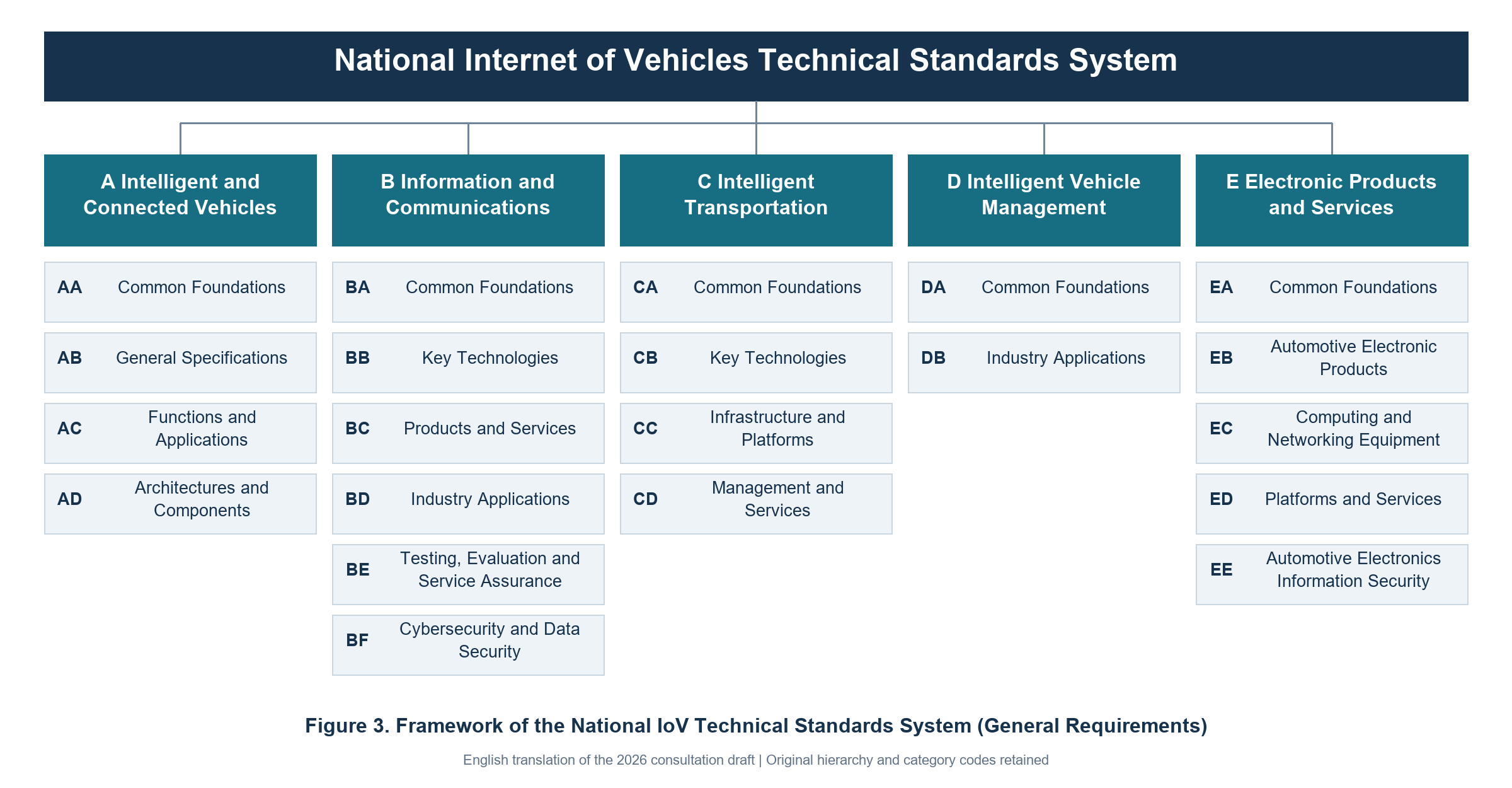
China Proposes Updated Internet of Vehicles Standards Roadmap Through 2030
Top Read Articles
Switch articles-
12-November-2026
China Proposes Updated Internet of Vehicles Standards Roadmap Through 2030
-
 11-November-2026
China’s MIIT Establishes Industrial Software Standards Committee
-
11-November-2026
China’s Draft Mandatory Vehicle Data Security Standard: Implications for Automotive Chip and Connectivity Suppliers
-
10-November-2026
China Sets New Mandatory Vehicle Geospatial Data Security Requirements
-
 10-November-2026
China Implements 4 Revised Mandatory Toy Safety Standards