
China’s Ministry of Industry and Information Technology (MIIT) has established a dedicated Industrial Software Standardization Technical Committee, strengthening the organisational framework for developing industry standards. Its inaugural meeting took place in Hangzhou, Zhejiang Province, on October 21, 2026. MIIT Vice Minister Xiong Jijun attended and delivered a speech, underscoring the importance attached to industrial software standardization.
According to MIIT, the committee’s establishment supports the translation of technological innovation into practical applications and the development of the industrial software sector. For international suppliers, the committee creates an important body to monitor as China develops standards affecting software products, integration and industrial deployment. MIIT meeting announcement
Committee Responsibilities and Leadership
Established through MIIT Announcement No. 27 of 2026, dated October 19 and published on October 22, the committee is designated MIIT/TC11. It is responsible for developing and revising industry standards covering key technologies, interoperability, products and services, integrated applications, and ecosystem development.
The first committee comprises 127 members, with its secretariat hosted by the China Electronic Product Reliability and Environmental Testing Research Institute, commonly known as MIIT’s Fifth Electronics Research Institute. MIIT/TC11 is a ministry-level technical committee and should be distinguished from national technical committees carrying SAC/TC designations. Official establishment announcement
Its leadership includes:
Chair: Guo Xu — Dalian University of Technology.
Executive Vice Chair: Yang Jianjun — MIIT’s Fifth Electronics Research Institute.
Vice Chair: Zhang Shunmao — Huawei Technologies.
Vice Chair: Zhu Min — China Center for Information Industry Development.
Vice Chair: Wang Jianmin — Tsinghua University.
Vice Chair: Wang Weiwei — MIIT’s Department of Information Technology Development.
Secretary-General: Zhang Baolin — MIIT’s Fifth Electronics Research Institute.
Membership Spans Software Development and Industrial Applications
The membership brings together software developers, industrial users, universities, research institutes and standardization organisations. Participating software companies include ZWSOFT, Shandong Hoteam Software, Beijing Yundao Intelligent Technology, Suzhou Tongyuan Software & Control Technology, SUPCON, Yonyou and Kylin Software.
Other members represent organisations including Dalian University of Technology, Tsinghua University, Shanghai Jiao Tong University and institutes under the Chinese Academy of Sciences. The list also includes representatives from artificial intelligence businesses and ecosystem organisations, such as Baidu and the OpenAtom Foundation.
Industrial users include China FAW, Chongqing Changan Automobile, Shougang Group, Sinopec Engineering Incorporation and organisations from the petroleum, nuclear power and shipbuilding sectors. This breadth gives the committee access to both software-development expertise and practical deployment experience.
Major International Suppliers Not Identified as Direct Members
BESTAO’s review did not identify Siemens, Dassault Systèmes, SAP, PTC, Autodesk, Ansys, Schneider Electric or Rockwell Automation participating under their own names in the published membership list.
However, describing the committee as having “no foreign-invested enterprises” would be inaccurate. The list includes entities with foreign-investment registration or Hong Kong joint-venture backgrounds, including Baidu Online Network Technology (Beijing) and Petro-CyberWorks Information Technology. These corporate structures should be distinguished from direct participation by European or US industrial software groups.
The absence of the named international suppliers also does not establish that they are excluded from future drafting groups, consultations or other technical activities. Participation arrangements require confirmation with the secretariat.
Analysis & Recommendations
Industrial-user participation deserves particular attention. Energy, shipbuilding, steel and automotive businesses may bring operational requirements into standards development, potentially influencing interoperability, data exchange, software adaptation and verification approaches.
For European and US suppliers, these developments could affect how products connect with Chinese industrial platforms, exchange engineering information and demonstrate suitability for local applications. The practical implications will depend on the specific


Top Read Articles
Switch articles-
 12-November-2026
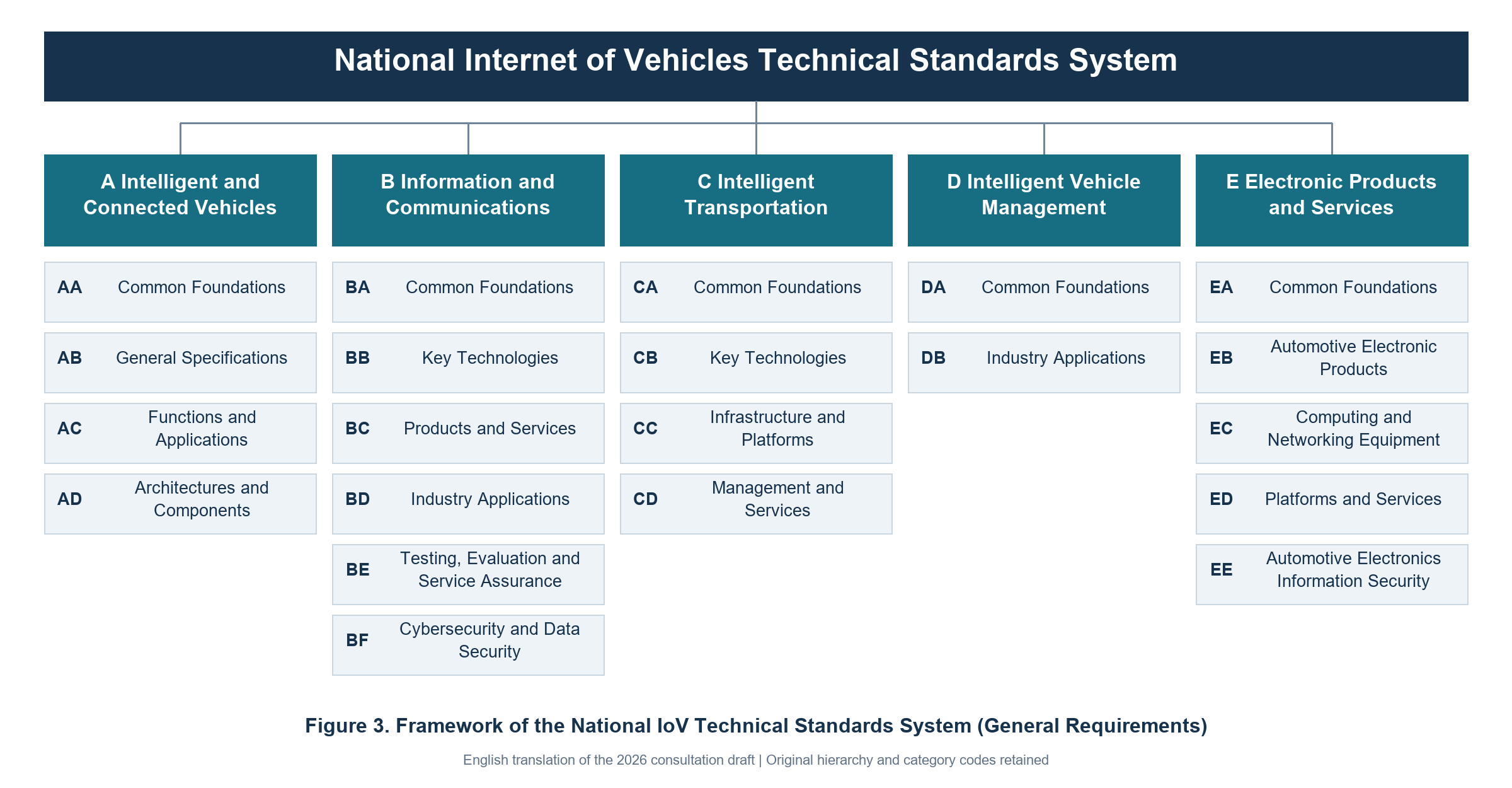
China Proposes Updated Internet of Vehicles Standards Roadmap Through 2030
-
 11-November-2026
China’s Draft Mandatory Vehicle Data Security Standard: Implications for Automotive Chip and Connectivity Suppliers
-
 10-November-2026
China Sets New Mandatory Vehicle Geospatial Data Security Requirements
-
 10-November-2026
China Implements 4 Revised Mandatory Toy Safety Standards
-
 04-November-2026
New China WEEE Rules Proposed to Strengthen Producer Responsibilities