

China’s National Data Standardization Technical Committee (SAC/TC 609) launched a public consultation on six draft recommended national standards on 16 November 2026. Covering general principles, civil aviation, telecommunications, industry, aerospace and geographic information, the package would provide a more structured basis for identifying important and core data.
The projects were approved on 22 May 2026 under China’s fifth batch of recommended national standard development plans for the year. Comments are invited until 16 January 2027, through the consultation section of the TC 609 website. The documents remain drafts, with no final standard numbers or confirmed implementation dates.
General Principles: A Common Framework for Identification
The General Principles draft establishes the architecture connecting national classification rules, sector-specific identification criteria and organisations’ own data catalogues. Building on GB/T 43697-2024, it distinguishes general, important and core data, while excluding state-secret and military data from its scope.
A central distinction is between an “identification catalogue” and an organisation’s “important data catalogue.” The former organises sectoral identification rules into a national standard. The latter records the important and core data actually held by a data processor and submitted to the relevant sectoral authority. Consequently, businesses would need to translate sectoral criteria into documented assessments of their own datasets.
The draft describes important data by reference to potential harm to national security, economic operation, social stability, public health or safety. It notes that data affecting only an organisation itself or individual citizens would generally not constitute important data. Core data represents a higher-risk category, including important data whose unlawful use or sharing could directly affect political security.
For authorities developing sectoral rules, the draft proposes both qualitative and quantitative reference criteria. Data covering a province or a higher geographical level would, in principle, be identified as important. Personal information concerning at least one million people, or sensitive personal information concerning at least 10,000 people, would also generally fall within the proposed important-data criteria.
For core data, the corresponding references include coverage across multiple provinces or nationwide, personal information concerning at least ten million people, or sensitive personal information concerning at least 100,000 people. However, these are proposed references for developing sectoral rules, subject to industry requirements and contextual assessment. They should not be presented as unconditional, universally applicable classification thresholds.
Technical information also receives attention. The draft connects important-data identification with restricted technologies under China’s technology export catalogue and core-data identification with prohibited technologies. It additionally addresses certain non-classified source data associated with classified information, and technical materials describing export-controlled items.
The proposed workflow comprises data inventory, identification and submission, authority review, notification of results, enhanced protection and subsequent updating. Sectoral authorities would review important-data catalogues, while proposed core-data catalogues would undergo review by the office of the national data security coordination mechanism.
Annex A supplies a reporting template covering data categories, quantity, coverage, precision, responsible entities, processing purposes, cross-border transfers, inter-entity flows and protection arrangements. Updates would be expected when datasets or identification rules change, including significant increases in scale or precision. The practical implication is that classification would become an ongoing governance process connected to business operations and data flows.
Five Sectoral Drafts Translate the Framework into Business Context
The industrial draft covers data generated or collected across research and design, manufacturing, business management, operations and maintenance, platform operation and application services. It highlights risks including major production accidents, supply-chain disruption and leakage of core technologies. Proprietary designs, process formulas and manufacturing control logic receive particular attention. The document provides an overarching industrial framework within which subsectors could develop more specific identification standards.
The telecommunications draft addresses both basic and value-added telecommunications businesses. Its categories include network planning and maintenance, security assurance, economic operation and business development, and key technological achievements. It incorporates criteria relating to network infrastructure, data centres, cloud platforms and AI application systems. Businesses should examine these detailed provisions rather than assuming that every dataset held by a large platform automatically receives the same classification.
The civil aviation draft covers areas including safety supervision, production and operation, aviation services, airport engineering and air traffic management. Its annexes address data classification examples, airport size categories and changes in data classification. For airlines, airports and service providers, the proposed approach would require assessments reflecting operational impact and the relevant identification conditions.
The aerospace draft organises data around research and production, satellite applications and in-orbit safety. It expressly recognises that aggregation, spatial-temporal association and cross-analysis can increase sensitivity. Historical mission and maintenance information may also retain long-term security significance.
The geographic information draft distinguishes basic geographic information, remote-sensing imagery and thematic geographic information. Its definition of data processors extends beyond licensed surveying entities. However, it excludes remote-sensing observations or products that, following processing, contain no spatial-location information and have no established spatial association.

BESTAO Analysis and Recommendations
BESTAO considers the package significant because it would make China’s important-data identification system more operational through common terminology, sectoral criteria and reporting structures. Nevertheless, the proposed GB/T standards should be distinguished from binding legislation. Their practical significance would depend on final wording, regulatory implementation and interaction with existing obligations.
One issue deserving consultation feedback is consistency between the general and sectoral texts. While the General Principles draft generally excludes data affecting only an organisation, the industrial draft gives explicit attention to proprietary commercial value and serious impacts on organisational rights. Businesses should seek clarification on how these considerations interact in actual classification decisions.
Multinational companies should map China-related datasets by business activity, responsible entity, storage location and sharing arrangement. Particular attention should go to overseas engineering collaboration, remote maintenance, group analytics and cloud services. These activities should be assessed against the relevant draft criteria without assuming that all cross-border sharing is prohibited.
Companies should also test whether existing inventories capture derived datasets and changes in scale, coverage or precision. Consultation submissions would be most useful where they identify concrete ambiguities, overlapping sectoral coverage or reporting fields that are difficult to implement. Early engagement can help businesses prepare while contributing practical evidence before the standards are finalised.

China Scraps CCC for 18 Mining Ex Products — What Still Applies?

China Sets New Mandatory Vehicle Geospatial Data Security Requirements

China’s Draft Mandatory Vehicle Data Security Standard: Implications for Automotive Chip and Connectivity Suppliers
Top Read Articles
Switch articles-
 16-November-2026
China’s MIIT Sets Out Industrial Carbon Control Framework with 400 Product Footprint Rules and Standards
-
 15-November-2026
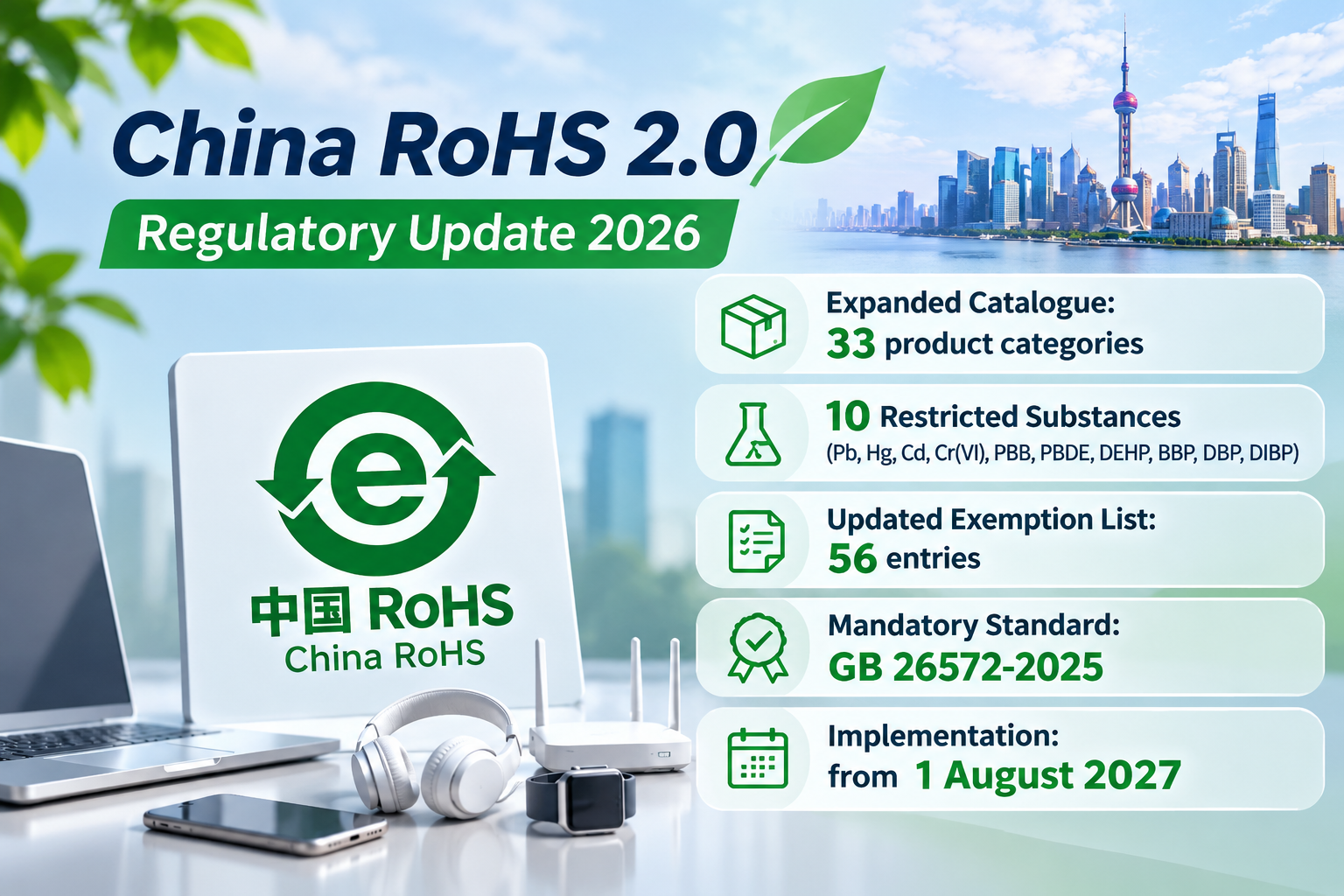
BESTAO Regulatory Update - China RoHS Enters a New Era
-
 12-November-2026
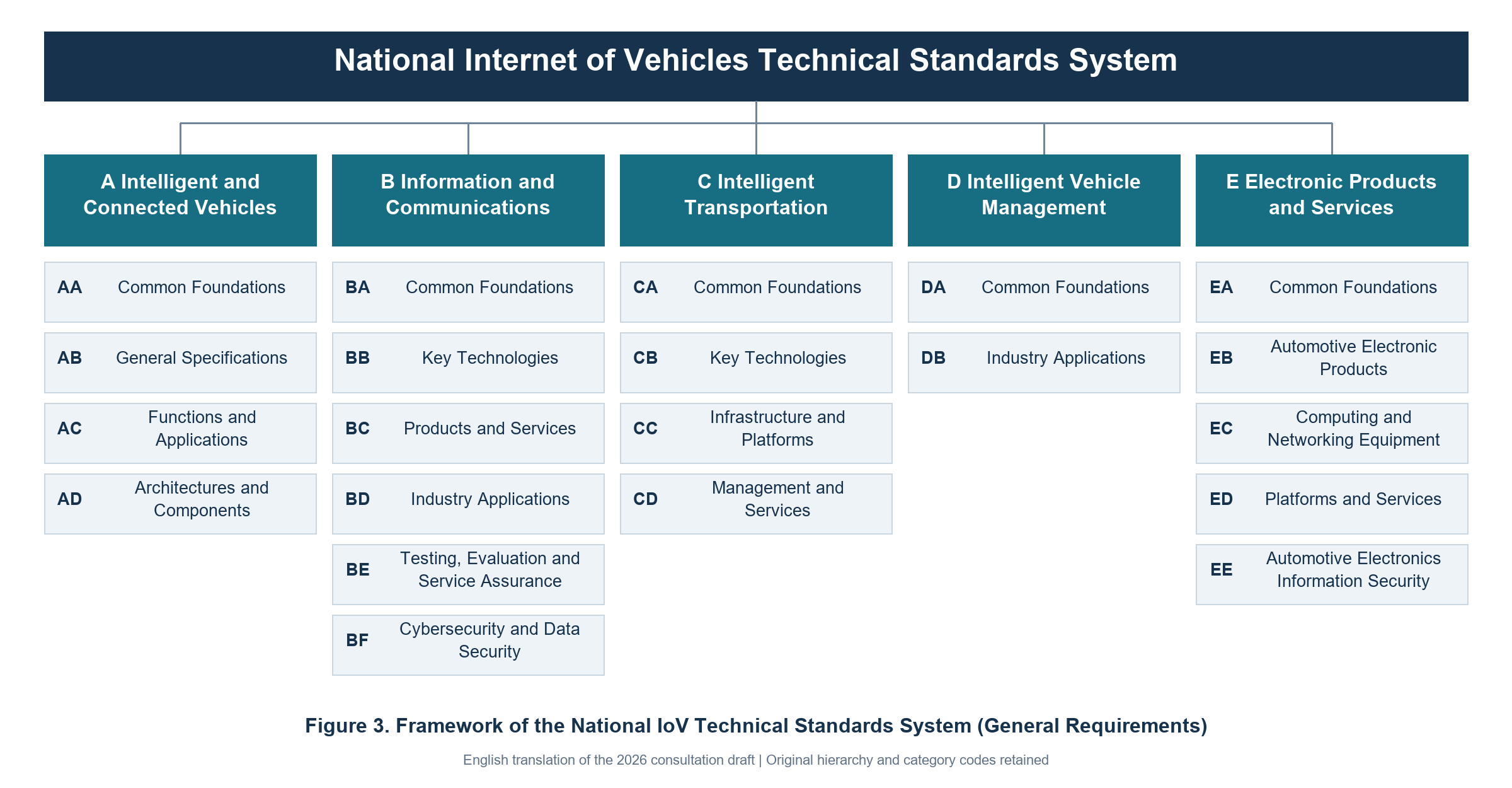
China Proposes Updated Internet of Vehicles Standards Roadmap Through 2030
-
 11-November-2026
China’s MIIT Establishes Industrial Software Standards Committee
-
11-November-2026
China’s Draft Mandatory Vehicle Data Security Standard: Implications for Automotive Chip and Connectivity Suppliers